
By Lawrence G. McMillan
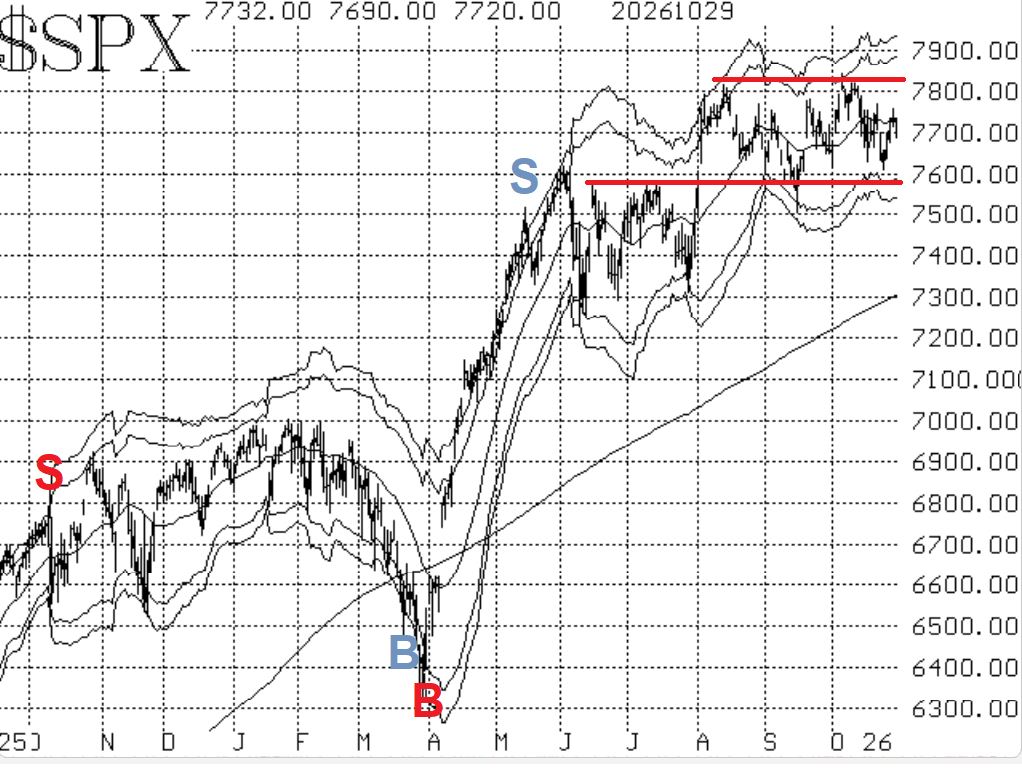
The market as measured by $SPX continues to trade in a narrow range between roughly 7600 and 7800. A clear breakout of that range would generate a momentum trade. Considering that the range is only about 3% of $SPX's value, it's amazing that it has lasted as long as it has. The broad market is presenting a different picture, and we'll get to that in the next article.
$SPX rallied earlier this week, but that was mostly a bounce off the latest test of the 7600 support level last Friday. That rally barely brought $SPX back up to its declining 20-day Moving Average. Now, after poor earnings by AMZN and INTC, $SPX is selling off again and is right back in the support range of 7580-7620.
Equity-only put-call ratios continue to rise, and that is bearish for stocks. As long as these ratios are rising, they will remain on sell signals.
Contrasting that to a very large degree is market breadth. It has improved considerably over the past couple of weeks. Both breadth oscillators are on buy signals, but this is mostly being reflected in the broader small-cap index ETFs, such as IWM and RSP (S&P equal weighted).
$VIX has been criss-crossing its 200-day Moving Average of late, so there is no trend of $VIX signal in place at this time. However, the "spike peak" buy signal is still in place for now.
In summary, the market is as starkly separated into two parts as ever. The large-cap $SPX remains locked in a trading range, and momentum trades are not feasible until that range is broken. Small caps have been faring better, although even they are succumbing to today's selling after the INTC earnings. Continue to roll deeply in-the- money (stock) options where appropriate.
This Market Commentary is an abbreviated version of the commentary featured in The Option Strategist Newsletter.

© 2023 The Option Strategist | McMillan Analysis Corporation